
RIMS-HDR CERTIFICATE PROGRAM IN QUANTITATIVE ERM
Live Virtual Program
Measure What Actually Matters in Enterprise Risk Management
The RIMS-HDR Certificate Program in Quantitative ERM is a three-week, interactive professional development experience delivered in partnership with Hubbard Decision Research (HDR). Most ERM programs run on heat maps, ordinal rating scales, and weighted scoring indices. They feel precise—but decades of research show they often add noise rather than insight, and can lead organizations to worse decisions than simpler methods would.
This program teaches the alternative. Across three live sessions, guided self-study, and group discussion, participants learn to build calibrated, data-informed risk models; apply Bayesian and statistical methods to real risk scenarios; and communicate quantitative results to leadership in terms that drive action. Participants will gain hands-on knowledge directly from Doug Hubbard—creator of Applied Information Economics and author of How to Measure Anything and The Failure of Risk Management—and the HDR faculty team.
The program is designed for risk professionals at every level, including experienced practitioners who are ready to move their ERM program beyond scoring rubrics. It is also a strong complement for RIMS-CRMP holders looking to add quantitative depth to their existing risk management practice.
Program Highlights:
- Duration: 3-week program
- Interactive Learning: Participate in live virtual sessions with the HDR faculty, group discussion, and structured self-study.
- Expert Instruction: Learn directly from Doug Hubbard and the HDR team during three 4-hour virtual sessions, totaling 12 hours of live instruction.
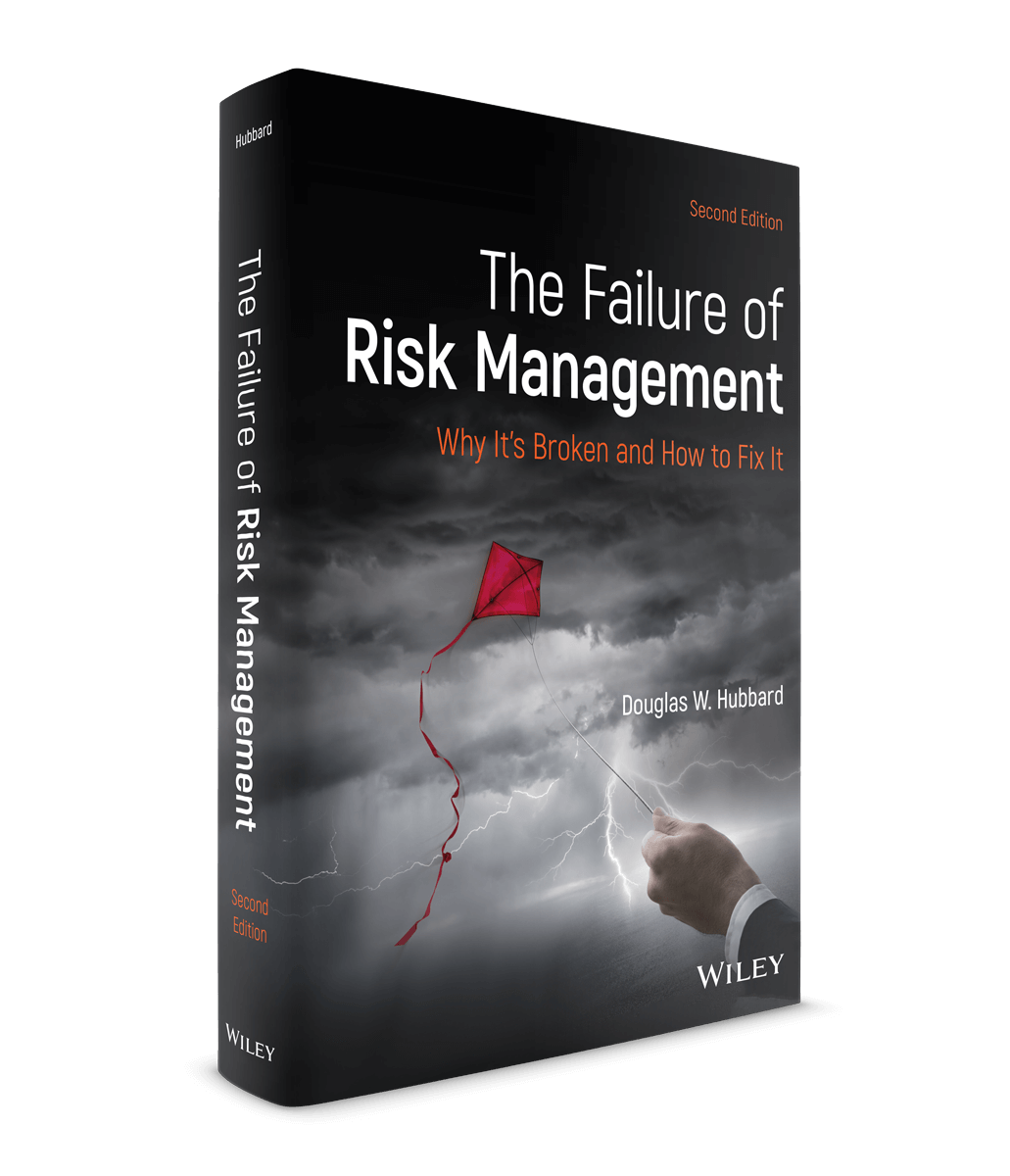
- Core Curriculum: Based on The Failure of Risk Management: Why It's Broken and How to Fix It, 2nd Edition, by Doug Hubbard (Wiley, 2020), purchased separately.
- Asynchronous Calibration Training: Self-paced Calibrated Probability Assessment training, completed alongside Module 1.
RIMS-HDR Certificate Program in Quantitative Enterprise Risk Management
Registration Fees
RIMS Members: $2,250 USD | Non-members: $2,500 USD (review registration details below)
COURSE MODULES
Module 1: How to Measure Anything in Risk Management, Quantitative Methods, and Calibration
Establishes why the most commonly used methods in risk management may actually make risk decisions worse, and addresses the persistent misconceptions about what can and cannot be measured. Introduces the quantitative methods used throughout the program, including a simple straw-man quantitative model participants can build immediately. Covers applying statistical measurement methods to analyze data and populate a model, how Bayesian methods inform event likelihood, and how past estimation performance can be leveraged to improve future forecasts. Includes a discussion of why quantitative models are wrongly held to a higher standard than human judgment and qualitative models. Paired with asynchronous Calibrated Probability Assessment training.
Module 2: Defining Risks and Incorporating Them into the Risk Model
Reviews the research behind pseudo-quantitative scoring methods such as risk matrices and ordinal scales, and why weighted scoring indices underperform relative to true risk quantification. Covers the limits of expert knowledge and the common errors that appear even in quantitative models. Group work focuses on how to capture and define risks inside a quantitative risk model, and how to populate that model using limited data combined with calibrated estimates.
Module 3: Improving the Initial Risk Model and Communicating Results
Builds on the initial model with additional quantitative techniques, including log-odds ratios (LOR), to sharpen probability estimates. Covers removing inconsistency from the model by addressing human error, fitting distributions from internal and external data, and using reference classes to overcome the uniqueness fallacy. Closes with the organizational side of quantitative ERM: how to communicate risk outputs to leadership, how to quantify and address risk tolerance to improve decisions, how to handle common objections to quantification, and what emerging risks—including AI—risk professionals should be preparing for.
UPCOMING COHORT
October 2026
Beginning October 8th, workshops will be held weekly from 10:00 AM to 2:00 PM ET.
Sessions will be recorded and shared for those who are unable to attend
Session Dates:
- Thursday, October 8th
- Thursday, October 15th
- Thursday, October 22nd
PROGRAM DELIVERABLES
Upon completion of the program, participants will receive a co-branded Quantitative ERM Certificate, and 21 CPE credits issued jointly by HDR and RIMS.
Participants will also gain access to:
- Asynchronous Calibrated Probability Assessment training.
- A working quantitative ERM model developed over the course of the program.
- Guided self-study readings mapped to each module.
- Opportunities for interactive Q&A and discussion sessions with the HDR faculty and peers.
Enroll in the RIMS-HDR Quantitative ERM Certificate Program to replace subjective scoring with measurement your organization can actually act on.
ABOUT THE INSTRUCTORS

Douglas W. Hubbard
Douglas (Doug) Hubbard is the founder of Hubbard Decision Research (HDR) and creator of Applied Information Economics (AIE), a methodology for measuring intangibles and quantifying uncertainty in complex business decisions. He is the bestselling author of How to Measure Anything and The Failure of Risk Management, the core text for this program, along with several other influential books on risk, measurement, and decision analysis.
For more than 30 years, Hubbard has helped organizations across financial services, cybersecurity, healthcare, government, insurance, and technology improve decision-making through quantitative risk analysis. His books have sold more than 190,000 copies in eight languages, and his work has been recognized by leading research firms including Gartner and Forrester. He is widely regarded as a leading authority on measurement, risk, and evidence-based decision-making.

Andrew Adams
Andrew Adams is Chief Executive Officer of Hubbard Decision Research (HDR) and an experienced data scientist specializing in statistics, quantitative decision analysis, and Applied Information Economics (AIE). He has worked with organizations across insurance, healthcare, pharmaceuticals, cybersecurity, and consulting services to improve decision-making under uncertainty.
Andrew has developed dozens of customized Monte Carlo simulation models that combine organizational data, industry research, calibrated estimates, and Bayesian methods to support complex business decisions. Prior to HDR, he worked with IBM and the BC Centre for Excellence in HIV/AIDS, applying machine learning and predictive modeling to healthcare challenges. He holds a Bachelor of Commerce from McGill University and a Master of Science in Applied Mathematics from Simon Fraser University.

Peter Mallik
Peter Mallik is Chief Operating Officer (COO) and Director of Cognitive Research at Hubbard Decision Research (HDR), where he applies cognitive science, quantitative analysis, and decision research to help organizations improve risk assessment and decision-making. Prior to his current role, he served as a Senior Quantitative Analyst at HDR, advising clients on complex valuation and measurement challenges.
Peter earned his Ph.D. in Psychology from The University of Akron, specializing in adult development, aging, and cognitive science. His research focused on understanding the sources of noise and bias that influence human judgment and decision-making. He is an active member of several professional organizations and has published research in leading journals, including Nature Human Behaviour, Experimental Aging Research, The Journal of Cognitive Psychology, and The Journal of Cognitive Enhancement.
TARGET AUDIENCE
This program has been developed for risk professionals at all levels—including ERM practitioners, risk analysts, risk managers, and senior risk leaders—who want to move their risk assessment practice from subjective scoring to quantitative measurement. RIMS-CRMP holders looking to add quantitative depth to their credential will find this program highly complementary. No advanced statistics background is required.
RIMS education courses are designed primarily for risk and insurance professionals, but anyone within an organization who wants to learn more about a specific topic of interest is encouraged to attend.
Level: Intermediate to Advanced
Format: Live virtual
REGISTRATION FEES
For registration assistance, please contact our Professional Development Team at PD@RIMS.org.
Cancellations and Refunds
RIMS reserves the right to cancel a course if conditions warrant. In the event of such a cancellation, registration fees will be refunded.
All requests for refunds or changes must be submitted in writing to RIMS at PD@RIMS.org. Registrants who cancel 15 business days or more prior to the start of the workshop can receive a credit to attend another workshop with the same duration and cost within three months.
You may cancel your registration at any time by emailing PD@RIMS.org. Cancellations received more than 30 days prior to the start of the event will receive a 100% refund. Cancellations received 15 to 30 days prior to the start of the event will receive a 50% refund. No refunds will be provided for cancellations received less than 15 days prior to the event. No refunds will be issued after the event. All refunds will be refunded to your original method of payment. Registrations may not be shared but may be transferred at no cost up to 15 days prior to the start of the event with notification to PD@RIMS.org.